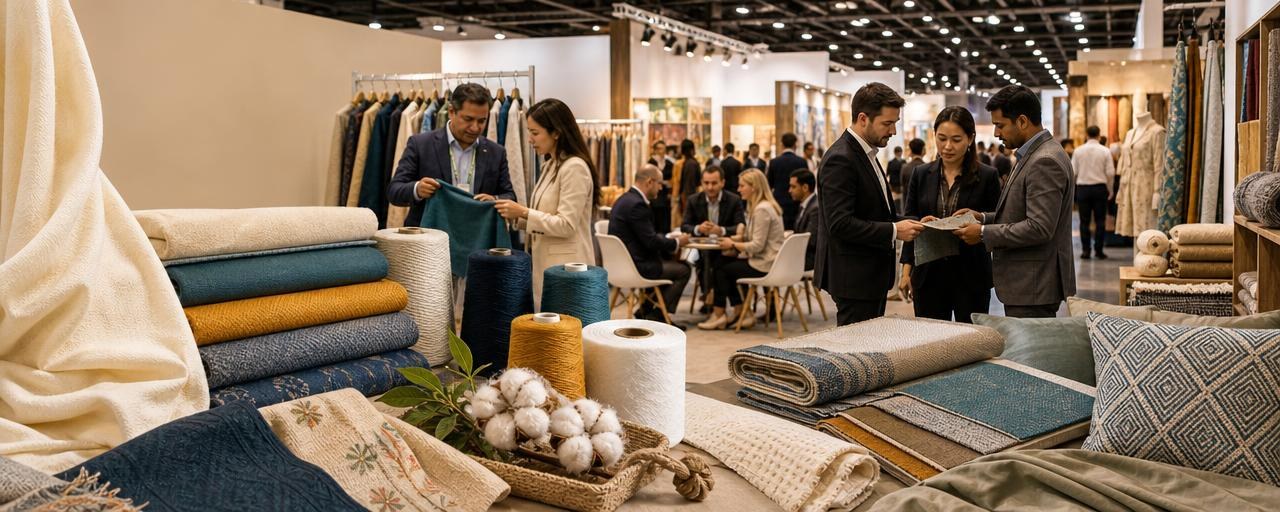
Bharat Tex 2027: a sourcing guide to India’s textile value chain
17–20 February 2027 · Bharat Mandapam, New Delhi, India
Bharat Tex is an international textile trade exhibition organised by Bharat Tex Trade Federation. Its published sector range covers textile raw materials, fibres and yarns, fabrics, home textiles, apparel and fashion, sustainable textiles and fashion accessories; the event website also identifies technical textiles within the wider textile offer. Buyers, manufacturers, exporters and product teams can use the show to examine materials, compare suppliers and plan commercial conversations across connected stages of textile production.
Bharat Tex 2027 at a glance
| Item | Information |
| Event | Bharat Tex |
| Edition | 2027 edition |
| Event type | International textile trade exhibition |
| Category | Textiles, home textiles, fabrics and yarns |
| Dates | 17–20 February 2027 |
| Opening hours | Not yet shown in the current 2027 visitor information; check the organiser’s latest arrangements before travel |
| City and country | New Delhi, India |
| Venue | Bharat Mandapam, Pragati Maidan |
| Organiser | Bharat Tex Trade Federation |
| Main sectors | Textile raw materials; fibres and yarns; fabrics; home textiles; apparel and fashion; sustainable textiles; fashion accessories; technical textiles |
| Core audiences | Textile and apparel buyers, importers and distributors, manufacturers, exporters and product teams |
| Latest published attendance | More than 120,000 trade visitors from over 120 countries were reported for the 2025 edition by India’s Press Information Bureau |
The dates and venue are listed for 2027. Review the event’s buyer and exhibitor information for current registration, programme and access details as they are updated.
Why Bharat Tex matters to textile businesses
Compare connected parts of the supply chain
The published categories span raw materials, yarns, fabrics, finished apparel, home textiles and accessories. That breadth can help a buyer compare upstream material options with the requirements of a finished collection, rather than evaluating one product in isolation.
Meet suppliers with a defined brief
Buyers can focus on product specifications, quality expectations, order volumes, delivery schedules and the role a supplier could play in their sourcing plan. Manufacturers and exporters can use those same conversations to explain product capability and the markets they serve.
Keep product discovery connected to industry knowledge
Knowledge sessions are part of Bharat Tex’s event platform. Their themes and timetable should be checked against the 2027 programme when published; visitors can use the sessions to complement product comparisons with relevant sector discussion.
Understand the scale of the international audience
India’s Press Information Bureau reported more than 120,000 trade visitors from over 120 countries at Bharat Tex 2025. This is a government-reported figure for that edition, not a forecast for 2027. It indicates the event’s international reach while leaving the 2027 attendance unconfirmed.
- Trade visitors: more than 120,000 in 2025, as reported by the Press Information Bureau.
- Countries represented among visitors: over 120 in 2025, as reported by the Press Information Bureau.
For buyers, the practical implication is to set priorities before arrival. For exhibitors, it is a reason to prepare a clear product story and a follow-up process, not a guarantee of a particular number of relevant meetings.
Exhibition sectors and product groups at Bharat Tex
The organiser’s published sector list provides a useful starting point for planning. The examples below are product lines to help visitors frame their searches within those sectors; they are not a promise that every item will be represented by a 2027 exhibitor.
Textile raw materials and technical textiles
- Cotton, wool, silk and other natural fibres
- Synthetic and man-made fibres
- Technical textile materials and applications
- Inputs for textile manufacturing and material development
Fibres and yarns
- Spun yarns and filament yarns
- Blended yarns and speciality threads
- Spinning, twisting and blending outputs
- Sewing threads and related materials
Fabrics
- Woven fabrics for apparel and interiors
- Knitted fabrics for clothing and performance uses
- Non-woven textiles for industrial and consumer applications
- Fabric constructions and finishes for different end uses
Home textiles
- Bed linen and bedroom fabrics
- Towels and bath textiles
- Curtain and drapery materials
- Upholstery and furnishing fabrics
Apparel and fashion
- Clothing collections and garment categories
- Apparel fabrics and material combinations
- Fashion concepts and seasonal product ranges
- Manufacturing and sourcing requirements for finished clothing
Sustainable textiles
- Organic textile materials
- Recycled fibres and materials
- Textile production processes positioned around sustainability
- Material traceability and product claims to evaluate with suppliers
Fashion accessories
- Buttons and fastenings
- Zippers and closures
- Labels and garment components
- Other accessories used to complete apparel ranges
When assessing a product, compare its composition, construction, performance, minimum order quantity, lead time, available certifications and sample policy. Request documentation that supports any technical or environmental claim before using it in a purchasing decision.
Who should visit Bharat Tex?
Textile buyers, importers and distributors
Useful if you are building or refreshing a supplier portfolio across textile materials, fabrics, apparel or home textiles.
- Compare suppliers within a clearly defined category
- Review material composition, construction and finishing options
- Check whether suppliers can support your target order volumes and delivery windows
- Explore products that could complement an existing distribution range
- Identify questions about samples, pricing, minimum quantities and after-sales communication
The organiser’s buyer information highlights exhibitor profiles, an interactive map and meeting scheduling. Use those tools to shortlist companies and arrange conversations where the 2027 platform makes them available.
Textile and apparel manufacturers
Useful if your business sources fibres, yarns, fabrics, accessories or finished products, or is assessing materials for a new production run.
- Compare raw materials and fabric constructions against product specifications
- Review options for apparel, furnishing and other textile applications
- Discuss consistency, repeat supply, lead times and quality documentation
- Assess potential suppliers before requesting samples or quotations
- Look for material combinations that fit a defined product or manufacturing brief
Manufacturers and exporters exhibiting
Useful if you produce textile materials, apparel, home textiles or accessories and want to present your range to trade visitors.
- Present a focused collection with clear specifications and use cases
- Explain the markets, order sizes and delivery conditions your company can support
- Prepare a process for recording buyer requirements and following up after the show
- Use discussions to understand where your offer fits alongside competing materials
- Review participation requirements and stand information with the organiser
Product, design and sourcing teams
Useful if you are responsible for material selection or product development in apparel, fashion, interiors or home textiles.
- Compare hand-feel, weave, knit, colour and finish across samples
- Check how a material meets the performance and care needs of its end use
- Explore links between fibre choice, fabric construction and finished-product design
- Document supplier capabilities and the next information needed for evaluation
- Keep sustainability claims separate from verified product evidence
Job roles likely to benefit include sourcing and procurement managers, textile buyers, import and export managers, product developers, designers, production managers, quality professionals, brand and retail buyers, and textile business owners. These role suggestions follow from the event’s published product sectors and commercial format.
Why visit Bharat Tex?
- Build a supplier shortlist: identify manufacturers and exporters whose raw materials, yarns, fabrics, apparel or home-textile ranges match a live sourcing need.
- Compare materials in context: examine samples side by side and record composition, construction, finish, intended use and supplier conditions.
- Connect product stages: consider how fibre and yarn choices affect fabric selection, garment development or home-textile production.
- Check accessory options: compare components such as buttons, zippers and labels against the requirements of a finished apparel range.
- Assess technical and sustainable claims: ask what specifications, testing or documentation supports a supplier’s product claims.
- Develop market conversations: use buyer and exhibitor interactions to identify what further samples, quotations or commercial information you need.
Why exhibit at Bharat Tex?
The event’s published sectors give textile manufacturers and exporters a platform to present products across raw materials, fibres and yarns, fabrics, apparel, home textiles, sustainability-related products and accessories. A business should decide whether to exhibit against its target buyers, product-market fit, stand budget and follow-up capacity.
- Present a coherent range: organise samples by material, application and specification so visitors can understand what the company makes.
- Qualify enquiries: prepare questions on buyer market, intended use, volume, quality requirements and decision timeline.
- Explain supply capability: be ready to discuss production capacity, repeat orders, lead times, sample availability and export documentation where relevant.
- Test portfolio fit: use conversations to learn which products buyers are evaluating and what information they need next.
- Plan follow-up: record contact details with permission, agreed next steps and the documents or samples to send.
Before committing, review the organiser’s current participation terms, stand options, costs and deadlines. For a cross-border sale or sourcing arrangement, check applicable import rules, product standards, payment terms and local representation with qualified advisers; the exhibition itself does not establish that a product meets a buyer’s requirements.
What makes Bharat Tex distinctive?
Its published range links material inputs, intermediate products and finished textile applications. The organiser identifies both foundational sectors—raw materials, fibres, yarns and fabrics—and downstream areas such as apparel, home textiles and fashion accessories, alongside sustainable textiles and technical textiles in its wider event description.
This makes Bharat Tex relevant to more than one point in the supply chain. A buyer can approach the show with a specific need, such as a fabric for a product line, or use the broader sector mix to compare connected inputs. A manufacturer can decide whether to present a focused specialism or show how its products support a wider end-use category. The actual 2027 exhibitor list and programme should guide final priorities.
Set useful objectives for Bharat Tex
If you are a buyer or distributor
Example objective: identify a shortlist of suppliers whose specifications, minimum quantities and lead times fit a named product range. Decide in advance which of those criteria is non-negotiable.
If you are a manufacturer or exporter
Example objective: present a defined product family to relevant buyer types and record the information each qualified prospect needs for a next step. Bring product data that is current and approved for external use.
If you work in product development or sourcing
Example objective: compare a set of fabric or accessory options against a written brief. Record composition, construction, performance, finish and required verification rather than relying on memory after the show.
If you are assessing sustainability or technical textiles
Example objective: find products or suppliers relevant to a specific application and document what evidence is available to support each claim. Ask for test methods, standards and traceability information where they matter to your decision.
How to prepare before Bharat Tex
1. Write a product brief
Describe the intended end use, material composition, construction, weight or performance range, colour or finish, target order quantity and required delivery window. Separate essential requirements from preferences so supplier comparisons stay consistent.
2. Create a shortlist
Use the organiser’s buyer information and exhibitor profiles when available. Group target companies as A—essential, B—useful and C—explore if time allows. The 2027 exhibitor list and interactive map should be checked as they are updated.
3. Arrange conversations
The organiser’s buyer page lists meeting scheduling among its visitor tools. Where the platform permits, request meetings with a concise explanation of your product need and the commercial questions you want to resolve.
4. Prepare textile-specific supplier questions
- What fibre composition and yarn or fabric construction does this product use?
- Which end uses and performance requirements is it designed for?
- What are the available widths, weights, finishes, colours or variants?
- What is the minimum order quantity for samples, trial orders and repeat orders?
- What are the normal production and delivery lead times?
- How is product quality checked, and which test reports or specifications are available?
- Can the supplier provide documentation for any stated recycled, organic or other sustainability claim?
- What packaging, labelling, payment and shipping terms apply?
- How are colour, shade and construction consistency managed across repeat orders?
- What information is needed to prepare a quotation or sample request?
5. Prepare your company materials
Bring a concise company profile, target product specifications and a way to record follow-up actions. If you exhibit, prepare clear product labels and accurate technical information; avoid claims that cannot be supported by documentation.
6. Confirm practical arrangements
Check registration status, opening hours, access arrangements and the final programme through the organiser before departure. The 2027 dates and venue are published, but opening hours and detailed programme information should be confirmed closer to the show.
How to make the most of the exhibition
Do not collect samples without a decision framework. For each product or conversation, record:
- Company: supplier name and the relevant contact.
- Product: fibre content, construction, finish, intended application and available variants.
- Why relevant: the requirement in your product brief that it could address.
- Evidence needed: specifications, test reports, sample, sustainability documentation or references.
- Commercial conditions: minimum order, lead time, price basis, payment and delivery terms to confirm.
- Next action: who will send or review what, and by when.
Photograph or label samples only with permission and preserve their supplier details. A fabric swatch without composition, construction and contact information is difficult to compare later.
Plan your time realistically
Bharat Tex is scheduled across four dates. Your ideal visit length depends on whether you are focused on one product category or comparing several parts of the textile chain. Do not assume that four days are necessary for every visitor; use the final floor plan, exhibitor information and programme to estimate the time you need.
- Before opening: check the route to the venue, registration requirements and meeting locations.
- First visit block: prioritise A-list suppliers and the sectors most closely tied to your brief.
- Middle block: compare alternatives, collect only relevant technical information and attend a confirmed session if it supports your goals.
- End of day: review notes, flag missing specifications and send any urgent follow-up while the conversation is fresh.
Opening hours and the 2027 daily schedule should be confirmed by the organiser before you build a detailed timetable.
Knowledge sessions and activity beyond the stands
Knowledge sessions are part of Bharat Tex’s official event platform. Their 2027 subjects, speakers and timetable should be checked when the organiser publishes the programme. If a session aligns with your work, note the question you want it to answer and leave time to connect the learning with the products or suppliers you are evaluating.
Do not plan around a session until its date and format are confirmed. The exhibition’s buyer information also describes venue navigation, session schedules, special events and networking as visitor-planning considerations; use the final event schedule to decide what belongs in your day.
Networking at Bharat Tex
Make introductions specific. Explain the product category you work with, the market or end use you serve, and the type of supplier or partner you are seeking. For a sourcing discussion, share the relevant specification and approximate requirements only when you are comfortable doing so.
- Ask what the company manufactures directly and what it sources from others.
- Clarify whether the displayed sample is standard, made to order or only illustrative.
- Agree which technical and commercial documents should follow the conversation.
- Record the right contact for samples, quotations or technical questions.
- Set a realistic next step instead of treating an exchange of business cards as a completed relationship.
Bharat Tex visitor profiles and business interests
| Visitor profile | Potential focus at the exhibition |
| Textile buyers and procurement teams | Compare fibres, yarns, fabrics, suppliers and commercial conditions against a sourcing brief. |
| Importers and distributors | Assess product range, supplier capability, order terms and potential fit with an existing portfolio. |
| Apparel manufacturers and brands | Review fabrics, accessories and apparel-related products for upcoming collections or production needs. |
| Home-textile businesses | Explore bed linen, towels, curtains and upholstery materials for interior and furnishing applications. |
| Product developers and designers | Compare material hand-feel, construction, colour, finish and suitability for a defined product concept. |
| Textile exporters and manufacturers | Understand buyer requirements and prepare product and capability discussions for trade visitors. |
| Technical and sustainability-focused professionals | Evaluate relevant technical textile or sustainability-related products and request supporting evidence. |
These interests are planning lenses drawn from Bharat Tex’s published sectors and buyer information, not a confirmed visitor breakdown for 2027.
Travelling to Bharat Tex
Bharat Tex 2027 is listed at Bharat Mandapam in Pragati Maidan, New Delhi. The organiser’s venue information describes several access options:
- Metro: the venue page identifies the Delhi Metro Blue Line and Pragati Maidan station, connected to Gate 10.
- Air: Indira Gandhi International Airport is listed as approximately 17 km from Pragati Maidan; the venue page mentions prepaid taxis and cab aggregators.
- Rail: New Delhi Railway Station is listed as approximately 3.9 km from Pragati Maidan.
- Road: the organiser describes access via the NH8 route towards Mathura Road and the city road network.
Distances and route conditions can vary with traffic and the final entrance. Confirm current access, transport and venue instructions for the 2027 edition before travelling.
Practical information for international visitors
| Item | Verified information |
| Venue | Bharat Mandapam, Pragati Maidan, New Delhi |
| Nearest metro guidance | Pragati Maidan station on the Blue Line; the organiser describes a connection to Gate 10 |
| Airport | Indira Gandhi International Airport, listed by the organiser at about 17 km from Pragati Maidan |
| Rail station | New Delhi Railway Station, listed at about 3.9 km from Pragati Maidan |
Check entry requirements for your nationality, confirm accommodation and local transport independently, and allow time for city traffic. Visa rules depend on the traveller’s passport and circumstances; do not treat event registration as a travel document.
One day or several days at Bharat Tex?
- One day may suit you if you have a narrow brief, have shortlisted suppliers in advance and only need to compare a focused set of products.
- Two days may suit you if you need to cover multiple sectors, hold planned meetings and leave time to evaluate samples and technical information.
- More time may be useful for a broad sourcing project spanning raw materials, fabrics, apparel or home textiles, or when confirmed knowledge sessions add relevant value.
These are planning suggestions, not an estimate of the venue’s size or a recommended duration for every visitor. Base your decision on the final exhibitor list, floor plan, opening hours and programme.
Bring a live textile project
A live brief makes conversations more useful. Bring the target end use, composition or performance needs, construction preferences, colour range, approximate quantities, target delivery period and any relevant quality requirements. For an apparel or home-textile project, note how the material will be cut, sewn, finished, cared for and replenished.
If comparing suppliers, use the same questions with each one. Ask for samples and supporting specifications, then record any differences in minimum order, lead time, price basis and documentation. For technical or sustainability-related materials, request the test or traceability evidence needed by your own compliance process.
After Bharat Tex: turn notes into decisions
Within a few days, sort contacts into three groups:
- A — Immediate evaluation: suppliers whose products appear to match a live requirement and need a sample, quotation or technical review.
- B — Potential fit: companies worth keeping in a supplier or partner shortlist after one or more questions are answered.
- C — Market intelligence: conversations that clarified material options, industry terminology or supplier capabilities but do not support an immediate purchase.
Follow up with the exact product, specification and next action discussed. Request current quotations, sample conditions, lead times, minimum order quantities and relevant documentation. Compare like with like, verify claims and make purchasing decisions through your normal quality, legal and commercial checks.
Bharat Tex visitor checklist
Before you go
- ☐ Confirm registration, opening hours, venue access and the latest programme.
- ☐ Write a product brief and rank target sectors and companies.
- ☐ Arrange meetings through the official visitor tools when available.
- ☐ Prepare supplier questions and a way to record technical details.
- ☐ Check travel documents, transport and accommodation requirements.
During the exhibition
- ☐ Compare products against the same specifications and end-use requirements.
- ☐ Record company, product, evidence needed and next action for every useful contact.
- ☐ Keep samples labelled and obtain permission before photographing.
- ☐ Separate verified product claims from statements that still need documentation.
- ☐ Review notes at the end of each day and adjust your priorities.
After the exhibition
- ☐ Send specific follow-up requests for samples, quotations or technical documents.
- ☐ Compare suppliers on quality, quantity, lead time, terms and evidence.
- ☐ Assign responsibility and a decision date for each promising contact.
- ☐ Keep useful market information even when no immediate purchase follows.
Is Bharat Tex worth visiting?
Bharat Tex is most relevant for professionals who have a textile sourcing, manufacturing, export, product-development or distribution objective. Its published coverage—from raw materials, fibres and yarns to fabrics, apparel, home textiles, sustainability-related products and accessories—can support comparisons across connected parts of the value chain. Visitors will get more from the show if they define a brief, use the organiser’s buyer tools and follow up with specific requests. A broad product range is useful only when it is matched to a decision you need to make.
Your Bharat Tex business question
What textile product, supplier or market question do you want to resolve in New Delhi? Set that objective before you travel, then use each conversation to discover, compare, verify and decide.
Specify. Compare. Verify. Follow up.
Textile and apparel opportunities in India
Market size and demand
Government export figures reported by India’s Press Information Bureau put textile exports, including handicrafts, at ₹3,16,334.9 crore in financial year 2025–26, up 2.1% from ₹3,09,859.3 crore in 2024–25. This is an export indicator for a broad category that includes handicrafts, not a measure of India’s total domestic textile market or the addressable market for every Bharat Tex product group.
- Textile exports including handicrafts: ₹3,16,334.9 crore in FY 2025–26, according to the Press Information Bureau.
- Year-on-year comparison: ₹3,09,859.3 crore in FY 2024–25; the reported total increased by 2.1%.
Policy context and commercial opportunities
The Ministry of Textiles’ PLI for Textiles portal states that the scheme supports production of man-made-fibre apparel and fabrics and technical textile products. The portal listed a Round 4 application window from 1 November to 31 December 2026 and notes amendments adding 17 HSN codes for MMF apparel and fabrics. This is a time-bound programme with eligibility conditions; companies should confirm the current rules and their eligibility directly with the scheme administrator.
- Materials and export portfolios: manufacturers and exporters may use Bharat Tex’s fibre, yarn and fabric sectors to compare product requirements and potential supplier or customer fit. Export value is a broad market indicator, not proof of demand for an individual product.
- Man-made fibres and fabrics: the PLI scheme’s stated focus may be relevant to companies assessing production plans, suppliers or technical capability in these categories. Participation does not itself confer scheme eligibility or a commercial contract.
- Technical textiles: the scheme identifies technical textile products as a supported segment; visitors can assess relevant products and request specifications, while exhibitors can explore how their offer fits a documented application.
- Apparel and home-textile sourcing: buyers may compare materials and suppliers represented across the event’s published sectors. They should verify production capacity, quality, order terms and applicable import requirements before making commitments.
What this means for exhibitors
Textile manufacturers and exporters may use the event to explain product capability and investigate relevant buyer or distribution conversations. A market-entry plan should separately verify product standards, customs duties, documentation, payment terms and local representation; no specific tariff or certification rule is stated here.
What this means for visitors
Buyers can use Bharat Tex to compare materials and suppliers against a defined requirement, while keeping the national export indicator in perspective. Ask for evidence at product level and confirm commercial and regulatory conditions before advancing a sourcing decision.
Explore Event Opportunities
Use Bharat Tex to find relevant textile suppliers, compare materials and explore a purposeful participation plan with ilikevents.
Get Expert Assistance from ilikevents to plan your visit or exhibition participation.
See the ilikevents services for this event
For further information, please click
here .