Origins of the Carnival of Venice:
The original Carnival of Venice took place in 1162 to honor one of Venice's victorious battles when the city was known as the "Repubblica della Serenissima." It took more than a hundred years before city leaders proclaimed Carnival an official event, and then it grew until its wild peak in the 18th century, when Venice was renowned as the pleasure capital of Europe, producing the likes of the famously hedonistic Casanova. But the glory days of Carnival came tumbling down when the party-crashing Napoleon invaded Venice in 1797. He killed Carnival for almost 200 years. It wasn't until 1979 that, in order to boost tourism, the city of Venice brought back this Old World-style party. In fact, this historic spin is what sets this Carnival apart from other famous celebrations like those in Rio or New Orleans.
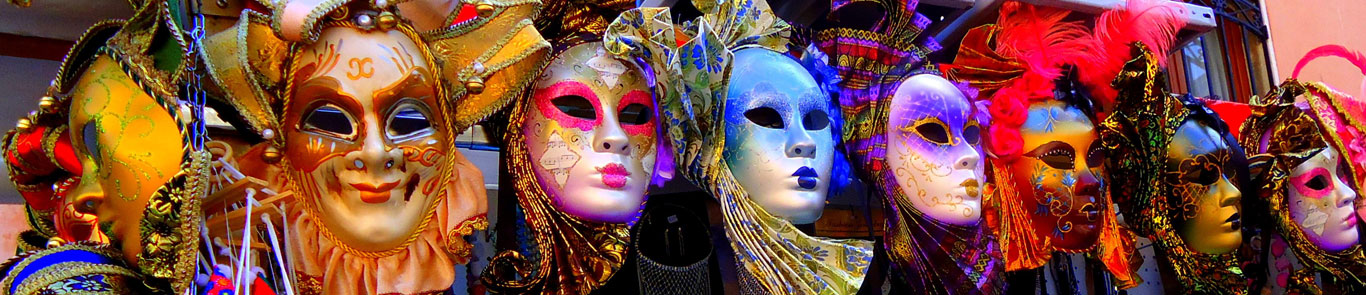
To best understand Carnival of Venice, you need to understand the importance of the maschera or masks. The mask allowed citizens to behave wildly and adopt alter egos without the fear of social consequence. This physical transformation permitted a judgment of character based purely upon the mask and costumes rather than roles of society.
Famous Masks:
Italian masquerade has several typical masks:
The Bauta is the most common and covers the upper face, nose and cheeks while allowing the wearer to eat, drink and speak freely. The Bauta was used in both Carnival and everyday life.
Moretta masks originated in France. Moretta means "dark" and represents the mysterious, a common theme during these ten days. It is feminine and covers the face with soft curves.
The Volto (Italian for "face") or Larva (Latin for "ghost") are the simplest "ghost masks" covering the entire face with decorated white and are accompanied by a cloak.
The most frightening of the bunch is the Medico della Peste or the Plague Doctor. A long beaked nose, overcoat and white gloves were thought to serve as protection during the 17th-century outbreak of the plague.
The most important event:
The most revered of the events is the official opening of Carnival at St. Mark's Square, which is the center of most festivities. Not to be missed is "The Flight of the Angel," which begins at noon and commemorates the 16th-century Turkish acrobats who wowed crowds with daring tightrope walks. In the modern-day celebration, an "angel" flies on a steel cable above the costumed crowd to the string music of Vivaldi. The plaza is packed with everyone from disguised dignitaries to the colorful masses. From there, the crowd disperses into the back alleys and canals to wander by foot and gondola.
For further information, please click
here .