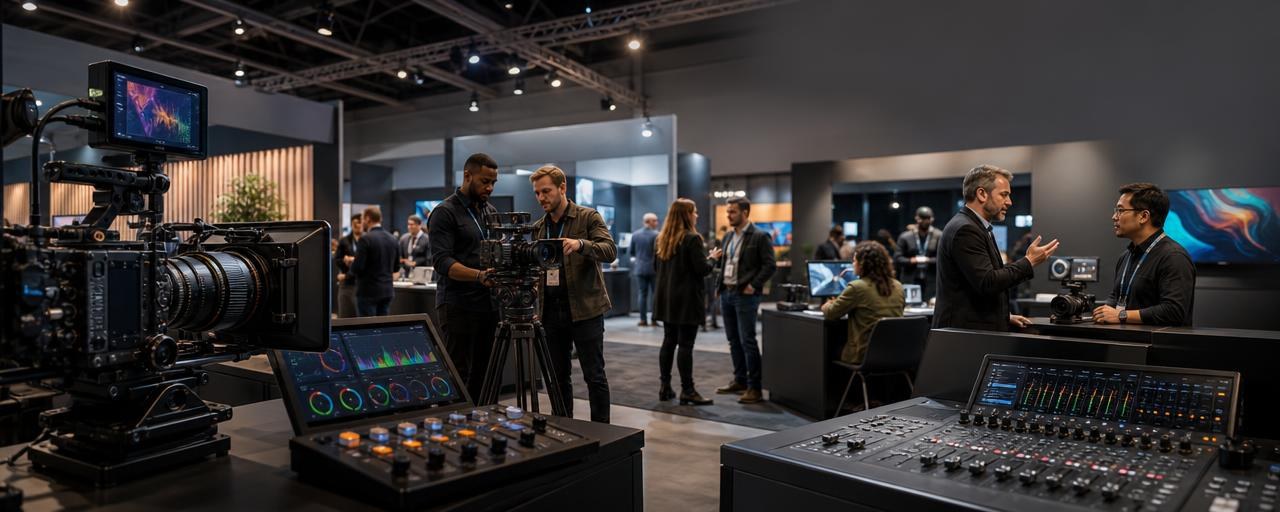
MPTS London 2027
12–13 May 2027 at the Grand Hall, Olympia London, London, United Kingdom. MPTS is the professional meeting place for production, broadcasting and content technology, connecting production teams, creators and technical professionals with tools, ideas and industry knowledge. Its 2027 programme areas include production, broadcast technology, post-production, audio, AI media and creator workflows.
MPTS London 2027 at a glance
| Item | Information |
|---|
| Event | MPTS London |
| Official name | MPTS |
| Edition | 2027 |
| Type | Business trade exhibition with a seminar programme |
| Category | Media and broadcasting |
| Dates | 12–13 May 2027 |
| Venue | Grand Hall, Olympia London |
| City and country | London, United Kingdom |
| Organiser | Media Business Insight (MBI) |
| Main programme areas | Production, broadcast technology, post-production, audio, AI media, creator workflows and media technology |
| 2027 programme | Eight theatres and 120+ sessions are advertised; programme details are being developed |
| Latest published scale | 2026 organiser-reported: 13,876 attendees and 310+ exhibitors and sponsors |
The 2027 dates and venue are confirmed by the event website. Use the organiser’s latest visitor information for registration details and the final programme before making plans.
Why MPTS London matters
Evaluate tools across a connected workflow
Content production involves creative, technical and delivery decisions that affect one another. MPTS brings production, broadcast technology, post-production, audio, AI media and creator topics into one exhibition and seminar setting. You can use that breadth to frame a practical question: which part of your workflow needs a better tool, a more reliable process or new technical knowledge?
Learn alongside product discovery
The organiser advertises a free seminar programme for 2027, with eight theatres and more than 120 sessions, including keynotes, discussions, masterclasses and specialist conference content. More than 300 industry speakers are also listed for the programme. This mix gives visitors a route to pair technology discovery with sessions relevant to their roles; check the published schedule when available and prioritise sessions against your objectives.
Meet a substantial professional community
The organiser reports 13,876 attendees and 310+ exhibitors and sponsors for 2026. These are figures for the previous edition, not forecasts for 2027. They indicate the scale of the event’s professional environment and support a focused approach: identify relevant suppliers and sessions in advance rather than trying to see everything.
Exhibition sectors and product groups at MPTS London
The 2027 event is organised around broad areas of media production and technology. Use the groups below as a way to plan what to investigate; the final exhibitor and session details should be checked against the organiser’s 2027 information.
Production technology
- Camera and image-capture systems
- Production equipment and supporting accessories
- Tools for studio, location and multi-camera workflows
- Virtual-production approaches and related technology
Broadcast technology and delivery
- Broadcast systems and technical infrastructure
- Media transport, distribution and delivery workflows
- Networked production and systems integration
- Operational technology for broadcasters and media organisations
Post-production and finishing
- Editing and post-production workflows
- Colour grading and finishing tools
- Visual effects and animation workflows
- Media management and collaboration tools
Professional audio
- Production sound and recording tools
- Audio monitoring and mixing workflows
- Sound design and post-production processes
- Audio technology for broadcast and digital content
AI media and emerging workflows
- AI applications relevant to media creation
- Tools for content production and workflow development
- Technical approaches to managing and delivering media
- Questions around how emerging tools fit existing teams and processes
Creator and digital-content technology
- Tools used by digital-first creators and podcasters
- Content capture and production workflows
- Technology for publishing and audience-facing media
- Solutions relevant to independent and small-team production
Who should visit MPTS London?
Production companies, broadcasters and content owners
Useful if your organisation commissions, produces or delivers screen and broadcast content. Focus on solutions that fit your production volume, workflow, technical requirements and delivery obligations.
- Production and studio managers
- Producers, directors and cinematographers
- Camera operators and lighting directors
- Post-production supervisors and editors
- Audio professionals and sound supervisors
Media-technology teams and suppliers
Useful if you specify, integrate, operate or sell technologies used to create and deliver media. Compare technical fit and implementation needs, and identify where a solution connects with your current systems.
- Broadcast and media engineers
- Technical and operations managers
- Systems integrators and solution architects
- Software, product and research-and-development teams
- Distributors, resellers and technology service providers
Creators and digital-first professionals
Useful if you make video, audio or other digital content and want to assess tools, production methods and ideas relevant to your work. Prioritise the creator-focused areas and sessions that match your format and technical needs.
- Filmmakers and content creators
- Podcasters and digital publishers
- Influencers and independent production teams
- Creative and multimedia producers
Why visit MPTS London?
- Compare production and broadcast technology against a defined workflow requirement rather than evaluating products in isolation.
- Identify suppliers or service providers relevant to a planned equipment, software or workflow decision.
- Use seminar and masterclass sessions to deepen knowledge in production, technology, post-production, audio or AI media.
- Discuss integration, support and operational needs with providers before advancing a technical evaluation.
- Explore creator tools and production approaches suited to your content format and team size.
- Build a shortlist of ideas and contacts for structured follow-up after the exhibition.
Why exhibit at MPTS London?
MPTS may suit companies supplying production, broadcast, post-production, audio, AI media and creator technologies or services. The organiser positions the event as a place to showcase solutions, meet prospects and existing customers, demonstrate products and develop business relationships. Its 2026 figures—310+ exhibitors and sponsors and 13,876 attendees—are organiser-reported and describe the previous edition.
Before committing, define which professional roles need to understand your solution, what demonstration would make its value clear, and how you will qualify follow-up conversations. International exhibitors should separately assess UK market requirements and the costs of serving customers; the production-spend figures in the UK opportunity section are not a forecast of equipment purchases. ilikevents can assist with participation planning and exhibitor coordination.
What makes MPTS London distinctive?
It places exhibition discovery beside a broad professional learning programme for the people behind media production and delivery. The 2027 event advertises eight theatres and 120+ sessions, with content across production, broadcast technology, post-production, audio, AI media and creator activity. More than 300 industry speakers are listed. The organiser also highlights interactive exhibition features and opportunities to meet peers. These are announced programme features; check the final schedule for session titles and timings.
Set useful objectives for MPTS London
If you are evaluating technology
Leave with a shortlist of solutions that meet one stated workflow requirement. Record the capability, integration question, support model and next technical step for each option.
If you work in production or post-production
Identify a small number of techniques or tools worth testing in a current or upcoming project. Note the format, team needs and constraints that will determine whether each is practical.
If you create digital content
Find tools or workflows that address a specific production bottleneck. Compare setup effort, output needs and compatibility with your existing process.
If you exhibit
Define the audience and use case for each demonstration. Capture follow-up actions and technical questions, not just names, so conversations can be assessed after the show.
How to prepare before MPTS London
- Choose a purpose. Decide whether your priority is sourcing, technical evaluation, learning, creative development or exhibiting. Set a short list of outcomes that can be checked after the event.
- Check registration. The organiser says full registration for 2027 opens in December 2026 and currently invites visitors to register interest. Confirm the registration terms and access details when published.
- Review the programme and exhibitor information. The 2027 schedule and exhibitor details may develop over time. Use the organiser’s latest lists to select relevant sessions and companies once available.
- Prioritise contacts. Group target companies as A: essential, B: useful, and C: explore if time allows. Prepare a concise question for each priority supplier.
- Write technical questions. Ask how a solution fits your formats and workflow, what it must integrate with, what support is offered, how it scales and what evaluation is possible after the show.
- Plan your learning. With many sessions across several theatres, select the topics most relevant to your role and leave time for the exhibition floor and conversations.
- Prepare for follow-up. Use a simple record: company, product or topic, why it matters, contact, and next action. Bring the project context needed to make technical discussions concrete.
How to make the most of the exhibition
Do not collect brochures without a decision in mind. For each relevant conversation, capture Company → Product or topic → Why it fits → Question to resolve → Next action. For a production tool, for example, note the intended use, required workflow connections and who in your team should assess it.
Compare solutions against the same criteria where possible. A demonstration can help you understand a product, but procurement decisions may also depend on compatibility, support, security, training, licensing and total cost. Confirm these details directly with the provider and your technical stakeholders.
Plan your time realistically at MPTS London
MPTS spans two event days and a programme advertised across eight theatres. Rather than trying to attend every session, reserve time for your priority exhibitors and the topics that support your objectives.
- Before the day: mark essential sessions and companies, allowing for transitions and unplanned conversations.
- First part of the day: attend a priority session or begin with your most important technical discussions.
- Middle of the day: compare exhibition solutions and capture notes while details are fresh.
- Later sessions: use remaining time for secondary topics, follow-up questions and new discoveries.
- At the end: review contacts and assign a next action to each worthwhile conversation.
Learning and programme at MPTS London
The organiser advertises a 2027 free seminar programme with keynotes, fireside chats, panel discussions, masterclasses and specialist content across eight theatres. Named areas include Keynote, Broadcast Technology, Production, Post Production, Audio, AI Media Zone, Creator Hub and SMPTS Media Technology Conference Europe. More than 120 sessions and 300+ industry speakers are listed. The final session titles, speakers and timings should be checked in the updated programme; treat announced themes as a planning guide, not a substitute for the schedule.
Networking at MPTS London
Make conversations specific. Prepare a short introduction that explains your role, the kind of content or system you work with and the question you are trying to solve. Ask providers how their products fit your use case; ask peers how they evaluate workflows, manage implementation or build technical capability.
Before each conversation ends, agree on a useful next step—such as sharing a specification, arranging a technical discussion or sending a product brief—only where both sides want to continue. Record enough context to remember why the contact matters.
MPTS London visitor profile and business opportunities
| Visitor profile | Potential focus |
|---|
| Producers and production managers | Production tools, workflow needs and project-specific requirements |
| Directors, cinematographers and camera operators | Image-making technology and production methods |
| Broadcast engineers and technical managers | Broadcast systems, integration and operational fit |
| Post-production professionals | Editing, finishing and media workflow topics |
| Audio professionals | Sound capture, mixing and audio post-production |
| Creators and podcasters | Content tools and creator-focused production workflows |
| Technology suppliers and service providers | Demonstrations, technical conversations and relevant industry contacts |
Travelling to MPTS London
The event takes place at the Grand Hall, Olympia London, at Olympia Way, London W14 8UX. Olympia’s visitor travel information identifies Kensington (Olympia) station as a nearby rail connection and directs visitors to check current transport status and journey details. Review the venue and organiser’s latest access guidance before travelling, since routes and arrangements can change.
Practical information for international visitors
| Item | Information |
|---|
| Venue | Grand Hall, Olympia London, Olympia Way, London W14 8UX, United Kingdom |
| Rail access | Kensington (Olympia) station is next to the venue; the venue’s current travel page provides journey guidance |
| Registration | Full registration for the 2027 event is scheduled to open in December 2026 |
Check entry and travel requirements that apply to your circumstances, confirm venue access arrangements and allow time for your route. ilikevents can help visitors plan their exhibition visit and arrange relevant travel support.
One day or both days at MPTS London?
One day
A single day may suit visitors with a narrow technical brief, a short list of priority suppliers or a small number of sessions. Plan the route and schedule carefully, and keep time for the conversations most relevant to your decision.
Both days
Two days may be useful if you want to combine several programme areas with broader exhibition discovery, or if your work spans production and technical operations. Use the first day to explore and the second to revisit shortlisted solutions or attend additional sessions.
After MPTS London: turn notes into decisions
Within a few days, sort contacts into three groups: A — immediate technical or commercial follow-up; B — promising options needing more evaluation; and C — useful market or workflow intelligence. For suppliers, request the information needed to assess fit, such as specifications, integration details, support arrangements, evaluation options and commercial terms.
Share relevant findings with the colleagues who will make or support a decision. Compare shortlisted options against the same needs and document what remains unresolved before moving to procurement or a trial. For learning, turn useful session ideas into one practical discussion or experiment with your team.
MPTS London visitor checklist
Before
- ☐ Define your main objective and the question you need answered.
- ☐ Check registration, current programme and exhibitor information.
- ☐ Prioritise sessions, companies and technical conversations.
- ☐ Prepare project context and questions for relevant suppliers.
During
- ☐ Record product, fit, open question and next action for each important conversation.
- ☐ Balance session attendance with time on the exhibition floor.
- ☐ Confirm any compatibility, support or evaluation details directly.
After
- ☐ Sort contacts by urgency and relevance.
- ☐ Send specific follow-up requests and share findings with decision-makers.
- ☐ Compare options against your requirements before committing.
Is MPTS London worth visiting?
MPTS is most relevant to people who work in media production, broadcasting, post-production, audio, content technology or digital creation and have a clear reason to compare solutions, develop knowledge or meet industry peers. The event’s exhibition and broad seminar programme can support several kinds of professional objective, but the value of a visit depends on choosing the right companies and sessions for your work. A focused plan is more useful than trying to cover every topic.
Closing thought
What do you need to understand, compare or improve in your media workflow? Make that the question behind your time at MPTS London.
Discover. Compare. Learn. Connect. Follow up.
Media production opportunities in the United Kingdom
Market size and demand
BFI’s official statistics report £6.8 billion in combined UK film and high-end television production spend in 2025. This measures production expenditure, not sales of broadcast or media-production equipment. Within that total, high-end television accounted for £4.03 billion and film production for £2.77 billion. The figures indicate substantial production activity, while not establishing how much was spent on technology or which suppliers can win business.
Market indicators
- Combined film and high-end TV production spend: £6.8 billion in the UK in 2025, as reported by BFI.
- High-end television production spend: £4.03 billion in 2025.
- Film production spend: £2.77 billion across 193 productions in 2025.
Commercial considerations
Ongoing production activity may create reasons for production companies, broadcasters and post-production teams to review equipment, software and workflow capacity. For technology suppliers, MPTS can be a place to present solutions and learn what technical teams are evaluating; for visitors, it offers an opportunity to compare offerings and identify questions for their own procurement process. These are possibilities, not evidence of a particular supply gap or guaranteed demand.
UK tax rules may also matter to some production companies: HMRC guidance sets out Audio-Visual Expenditure Credit eligibility and qualifying conditions for specified film and television production companies. It also describes additional treatment for qualifying visual-effects costs. These rules apply to qualifying production companies and productions, not automatically to equipment exhibitors or every media business; check current eligibility with HMRC or a qualified adviser.
What this may mean for exhibitors
Suppliers may use conversations at MPTS to understand production and technical requirements, demonstrate relevant capabilities and assess whether their offer fits a particular workflow. The production-spend figures provide sector context only; exhibitors should validate product demand, procurement cycles, technical requirements and service expectations with prospective customers.
What this may mean for visitors
Visitors may compare tools against planned productions or operational needs, explore how a supplier supports implementation and identify follow-up questions for technical and procurement colleagues. The BFI figures describe the scale of film and high-end television production, not the budget or purchasing intentions of individual attendees.
Explore Event Opportunities
Use MPTS London to discover relevant media technologies, build industry knowledge and plan purposeful conversations with suppliers and peers. ilikevents can help you shape a visit or exhibition-participation plan around your professional objectives.
Get Expert Assistance from ilikevents to plan your visit or participation.
See the ilikevents services for this event
For further information, please click
here .