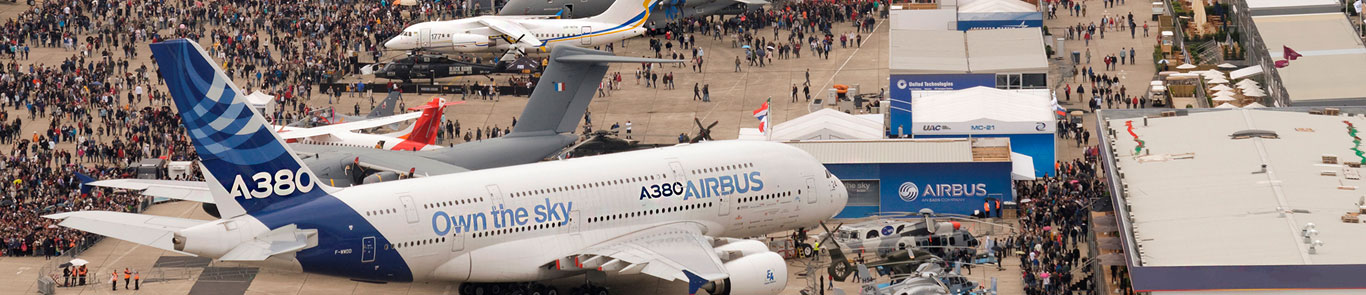
Paris Air Show 2027: the aerospace industry in one place
14–20 June 2027 · Parc des Expositions du Bourget, Le Bourget, Paris, France.
The Paris Air Show is an international aerospace exhibition organised by SIAE, a GIFAS subsidiary. It brings together civil and defence aviation and the space sector, with manufacturers, decision-makers, institutional delegations, start-ups, talent and media among the stakeholders named by the organiser. For visitors, the value is not simply seeing aircraft: the show combines product displays, an outdoor aircraft presence, flying demonstrations and professional exchange. Buyers can compare technologies and identify questions for suppliers; engineering teams can follow technical directions; exhibitors can present capabilities and explore prospective relationships. The 2027 programme and visitor arrangements should be checked as the organiser publishes edition-specific details.
Why the Paris Air Show matters
See aerospace technologies in context
Aircraft and aviation systems are easier to evaluate when you can examine a component, compare its presentation with adjacent technologies and speak directly with the people responsible for it. The show’s combination of exhibition stands, aircraft displays and flying demonstrations gives visitors more than a catalogue view of aerospace products.
Compare civil, defence and space priorities
The event covers civil and defence aviation as well as space. This breadth can help suppliers and decision-makers understand where technologies overlap and where requirements diverge, while keeping sector-specific questions in view. The organiser identifies competitiveness, decarbonisation, environmental challenges, defence, new industrial capabilities, space, new mobility and drones among the transformations shaping its programme.
Make professional conversations more purposeful
The official visitor information describes conferences, round tables and dedicated meeting programmes alongside activity on the stands. These formats can support a deeper look at industry challenges and a more structured way to meet relevant contacts. The detailed 2027 programme is not yet listed on the official programme page.
Understand the event’s scale
- 305,000 visitors: the latest published visitor figure located, for the 2025 edition.
- International scope: the organiser describes participation by manufacturers, decision-makers, official and institutional delegations, start-ups, talent and media.
- Every two years: the show’s organiser describes the event as biennial.
The 2025 visitor figure indicates a large and varied audience, so a focused target list and meeting plan can be more useful than trying to see every display.
Who should visit the Paris Air Show?
The show serves several audiences. Decide which part of the aerospace supply chain matters most to you before choosing what to prioritise.
Procurement teams, buyers and decision-makers
Useful if you need to identify suppliers, compare technical offers or understand where a product might fit a future programme.
- Shortlist manufacturers and suppliers relevant to a defined aircraft, subsystem or space requirement.
- Compare specifications, integration assumptions, support models and evidence offered for each product.
- Use dedicated meeting opportunities described by the organiser to make conversations more targeted.
- Prepare questions about certification, interfaces, service life, documentation and delivery assumptions.
- Record what requires a technical, commercial or compliance review after the show.
The organiser names manufacturers and decision-makers among the international stakeholders brought together by the event.
Engineers, technical specialists and programme teams
Useful if you are assessing technology, materials, industrial capability or engineering approaches across aviation and space.
- Compare aircraft systems, propulsion, structures, avionics and other aerospace technologies relevant to your work.
- Look for evidence of system interfaces, qualification status and intended operating context.
- Use conferences and round tables, when included in the 2027 programme, to follow industry challenges beyond individual products.
- Ask how a proposed solution addresses safety, environmental performance, maintainability and integration.
- Capture technical claims separately from verified specifications so they can be checked with your team.
The organiser identifies civil and defence aviation, space, new industrial capabilities and environmental challenges as central themes.
Exhibitors, manufacturers and aerospace service providers
Useful if your organisation develops or supplies products, technologies or services for civil aviation, defence aviation or space.
- Define the applications and customer roles you want to reach before preparing stand conversations.
- Bring concise evidence on product capability, interfaces, qualification and support.
- Use the event to explain where your offer fits, rather than relying on a broad company introduction.
- Prepare a clear follow-up request for technical, procurement or partnership discussions.
- Check current participation options with SIAE: the official exhibit page says all 2027 exhibition space is fully booked, while its team remains available for enquiries.
The event’s professional mix includes manufacturers and international decision-makers, but participation does not guarantee meetings or commercial outcomes.
Start-ups, talent, media and the general public
Useful if you want to understand aerospace innovation, career directions, industry debates or the public-facing experience of aviation.
- Start-ups can identify the sector themes and established stakeholders relevant to their technology.
- Students and early-career professionals can use the event to map roles across manufacturing, engineering, aviation and space.
- Media can follow the themes and projects presented by participating organisations, checking claims at source.
- General visitors can focus on aircraft displays and flying demonstrations, subject to the 2027 public-day arrangements.
- Check the organiser’s current visitor information for the audience-specific schedule and access conditions before making plans.
The official site provides separate professional and general-public entry points; the programme and daily arrangements for 2027 should be confirmed when published.
What can you find at the Paris Air Show?
Civil aviation
The civil aviation focus spans aircraft, systems, technologies and industrial capabilities. Visitors can use the exhibition to identify relevant suppliers and compare how products are positioned for different technical or commercial needs. Bring the aircraft type, subsystem, operating context or programme requirement that frames your search.
Defence aviation
Defence aviation is a core sector of the show. Professionals can use the event to understand the technologies and industrial capabilities on display, while checking suitability, approvals and procurement conditions through the appropriate formal channels. Keep sensitive requirements and export or security considerations within your organisation’s established processes.
Space
The space sector is included alongside aviation. The organiser’s visitor information highlights a dedicated space hub in its show imagery. Visitors interested in space technologies can use this context to identify relevant exhibitors and questions, then verify specific product capabilities and programme status directly with the responsible organisations.
Emerging technologies and industry priorities
The organiser identifies space, new mobility solutions, drones, decarbonisation, environmental challenges, competitiveness and new industrial capabilities among the transformations shaping the sector. These themes can help you organise a visit around a question—such as propulsion, materials, manufacturing capability or uncrewed systems—rather than collecting unrelated product information.
What makes the Paris Air Show different?
It combines aerospace products, aircraft activity and professional exchange in one international event.
Visitors can move between stands and aircraft displays, and the event includes flying demonstrations. The organiser’s visitor information also describes conferences, round tables and dedicated meeting programmes for professional visitors. These formats connect the product view with discussion of industry challenges, although the detailed 2027 schedule has not yet been published.
The show’s subject range—civil aviation, defence aviation and space—makes it relevant to different parts of the aerospace ecosystem. That breadth is useful for cross-sector awareness, but it also makes prioritisation important: buyers should use a requirements list, and technical visitors should separate directly relevant systems from themes they are monitoring.
What should you try to achieve during your visit?
If you are a buyer or procurement professional
Set a measurable objective such as: Identify a shortlist of suppliers for one defined subsystem and record the evidence needed for a formal comparison. Note the product, intended application, integration assumptions, qualification evidence, support model and next contact.
If you are an engineer or programme specialist
Set an objective such as: Compare three approaches to a technical challenge and document the questions that need follow-up with design or certification teams. Keep product claims distinct from independently reviewed technical evidence.
If you exhibit
Set an objective such as: Explain the fit of one product or capability to each priority customer group and agree a specific next technical discussion where there is mutual interest. The 2027 exhibition space is listed as fully booked, so check directly with the organiser before assuming a stand is available.
If you are a student, start-up or general visitor
Set an objective such as: Choose a small number of aerospace themes and leave with a clearer map of the people, technologies and questions connected to them. A focused plan makes a large event easier to navigate.
How to prepare before the Paris Air Show
1. Define the decision or question
Write down what you need to source, compare, learn or explain. Examples include finding a supplier for an identified aircraft system, assessing a material or production capability, understanding a space segment, or following a decarbonisation challenge. A precise question helps you decide which conversations deserve time.
2. Build a target list
The organiser’s visitor page currently links a 2025 exhibitors’ digital catalogue and a 2025 interactive show map. Treat them as reference material for the previous edition, not as a confirmed 2027 directory or floor plan. When the organiser releases current-edition tools, use them to identify relevant companies, stand locations and programme items.
3. Rank meetings and exhibits
Sort targets into three groups: A — essential for your project or sourcing need; B — useful for comparison or a possible partner discussion; and C — explore if time allows for market awareness. Check whether meeting arrangements are available for your audience and whether you need to request appointments through the official channels.
4. Prepare aerospace-specific questions
- Which aircraft, spacecraft, subsystem or operating application is this product designed for?
- What are its interfaces, operating limits, mass, power or environmental constraints?
- What qualification, certification or test evidence is available, and which authority or standard applies?
- How does the product integrate with existing systems and what assumptions does integration require?
- What maintenance, repair, overhaul or lifecycle support is included?
- Which materials, manufacturing processes and supply-chain dependencies are critical?
- What environmental-performance information is documented, and how was it measured?
- Which technical documents can be shared after the show, and under what confidentiality conditions?
- What are the indicative lead-time, production-capacity and service assumptions, subject to formal confirmation?
- What is the next technical or commercial step, and who owns it?
5. Plan around programme and access information
The 2027 programme page does not yet list detailed sessions. Recheck it before travelling, along with visitor registration, trade or public-day arrangements, opening times, venue access and the current show map. Do not rely on previous-edition schedules for the 2027 edition.
How to make the most of the exhibition
Use a consistent note for every useful conversation: Company → Product or capability → Why it fits → Evidence to request → Contact → Next action. For example, if you are comparing an aircraft subsystem, record the specific application and interface assumptions, rather than writing only “interesting technology.”
When you see a product display, distinguish what is demonstrated from what is claimed. Ask what configuration is shown, what qualification or test evidence exists, and which operating conditions the claim covers. For aircraft displays and flying demonstrations, record what you observed separately from any technical interpretation.
Use the 2027 exhibitor directory, interactive map and event programme once the organiser releases them. The tools currently linked from the visitor page are labelled for 2025; they may help with background research but should not be treated as the next edition’s layout or exhibitor list.
Take breaks to update your notes and adjust priorities. If a stand or session is not relevant to your stated objective, move on rather than collecting material without a follow-up use.
Plan your time realistically
The event runs across 14–20 June 2027 and covers several major aerospace sectors, so the right amount of time depends on your objectives, the 2027 programme and the access arrangements for your audience. The official site has not yet published detailed daily hours or a full programme.
For a focused visit
Choose one primary objective—such as supplier comparison, a technical theme or aircraft displays—and build a short list of essential targets. Confirm the relevant day’s audience access and any meetings before committing to a schedule.
For a multi-theme visit
Allow separate blocks for the sectors or questions that matter to you, such as civil aviation, defence aviation and space. Keep a buffer for walking, follow-up conversations and programme changes, and prioritise confirmed meetings over an ambitious list of every stand.
For a public visit
Use the organiser’s public-day information and current daily schedule to choose aircraft displays and demonstrations. Do not assume trade-day access or previous-edition timing applies to your selected day.
Beyond the exhibition floor
Professional visitors can look for conferences, round tables and dedicated meeting programmes, which the organiser’s visitor information describes as ways to explore sector challenges and meet relevant contacts. These are useful complements to product displays: a session can frame the issue, while a stand conversation can help you ask how a specific technology addresses it.
The organiser’s visitor page also presents the Paris Air Lab and Paris Space Hub in show imagery. Their status, format and schedule for 2027 should be verified when the edition programme is published; do not assume that a previous display or programme item will return unchanged.
At the time of this guide, the official programme page shows no detailed 2027 session list. Recheck the current programme before setting meeting times or travel around a particular presentation.
Networking with purpose at the Paris Air Show
Prepare a short introduction that states your role, the aerospace application you care about and the kind of information or contact you are seeking. For technical conversations, be ready to explain the system context and constraints without sharing confidential details. For commercial discussions, state the market, customer type or partnership model you are exploring.
Use a useful conversation structure
- Explain your application or capability in one or two sentences.
- Ask the other party to describe the product’s intended use and evidence.
- Check whether the technical and commercial fit is plausible before exchanging extensive material.
- Agree a specific next action—such as a technical document, a follow-up call or an internal review—where appropriate.
- Record permission and context for any follow-up, and handle restricted or sensitive information through approved channels.
A contact is useful when you can explain why it matters and what should happen next. A stack of unprioritised business cards is not a follow-up plan.
Travelling to the Paris Air Show
The event takes place at Parc des Expositions du Bourget in Le Bourget, within the Paris area. The official visitor and useful-information pages should be checked for current access instructions, entrances, transport advice, parking and any shuttle arrangements for the 2027 edition. None of those day-specific details should be inferred from the 2025 map.
Before travelling, confirm the venue access plan for your visitor category, the route to the correct entrance, the day’s schedule and any registration requirements. If you are travelling with equipment, samples or technical material, check the organiser’s current rules and your organisation’s security procedures in advance.
One day or several days at the Paris Air Show?
There is no single right duration for every visitor. Choose based on the number of sectors you need to cover, confirmed meetings, the current programme and the public or trade access arrangements.
One day
- Worth considering when you have one primary goal and a short, ranked list of companies or displays.
- Confirm locations and meeting times as soon as the 2027 tools are available.
- Keep unplanned exploration secondary to the essential targets.
More than one day
- May suit visitors comparing multiple sectors, attending confirmed sessions or arranging several supplier discussions.
- Separate the technical, commercial and market-intelligence objectives so each day has a clear purpose.
- Revisit priority companies only when there is a specific evidence gap or next decision to resolve.
For public and aviation enthusiasts
- Choose days using the organiser’s published public programme and aircraft-display information.
- Check daily opening and demonstration details before travelling; they are not yet confirmed here for 2027.
If you have an aerospace project
Bring a short, non-confidential project brief. State the aircraft or space application, system boundary, operating environment, integration constraints, required evidence, target decision date and the types of supplier or partner you need to evaluate. Where relevant, note mass, power, thermal, vibration, maintenance and lifecycle requirements.
For a product comparison, use the same questions with each supplier. Ask for documentation on performance, qualification, certification status, interfaces, testing and support, and note which claims still need independent review. If you are exploring a new technology, distinguish a concept demonstration from an operationally qualified product.
For exhibitors, prepare evidence matched to the audience: a concise product explanation for general visitors, and application, integration, qualification and support details for technical and procurement discussions. The 2027 exhibit page currently states that exhibition space is fully booked; contact the organiser for current enquiries rather than assuming a stand can be secured.
After the Paris Air Show: turn information into decisions
Within a short time after the visit, sort notes and contacts into three groups:
- A — immediate: directly relevant to a live project, procurement decision or agreed technical follow-up.
- B — potential: worth validating as a supplier, partner, technology or future capability.
- C — market intelligence: useful context, but not linked to a current decision.
For A contacts, send a concise follow-up that recalls the application and agreed next step. Request the documents needed for evaluation—such as specifications, interface information, test evidence, qualification status, maintenance scope, production assumptions or commercial terms—rather than asking for a generic presentation.
Compare like with like. Record open questions, evidence quality, product configuration and any assumptions that could change technical fit. Route certification, export-control, security and procurement questions to the appropriate specialists in your organisation. Keep a dated record of decisions and owners so the show’s information can support an actual next step.
Who should consider exhibiting?
The Paris Air Show is relevant to manufacturers and organisations with capabilities in civil aviation, defence aviation or space, as well as suppliers and technology companies serving those sectors. The event provides stands in halls, business chalets, outdoor areas and static aircraft display options in its exhibitor information.
The official exhibit page states that all exhibition space for 2027 is fully booked. It also says the organiser’s team remains available for enquiries. Companies considering participation should check directly with SIAE for current options, services and eligibility rather than assuming space is available.
Set an exhibitor objective
- Choose the product or capability you want a defined audience to understand.
- Identify the customer roles and applications for which it is relevant.
- Prepare concise technical evidence, qualification information and support details.
- Define what would count as a useful next step: a technical review, a qualified follow-up or a partner discussion.
- Plan how to record enquiries and assign follow-up responsibility.
Exhibiting can create opportunities to present expertise and meet industry participants, but commercial results depend on product fit, preparation and follow-up.
Paris Air Show visitor checklist
Before the show
- ☐ Define the decision, sourcing need or technical question you want to address.
- ☐ Check the 2027 registration, access category, opening times and current programme.
- ☐ Use the 2027 exhibitor list and map when they are released; treat current 2025 tools as previous-edition references.
- ☐ Rank target companies and meetings by importance.
- ☐ Prepare application-specific questions and a non-confidential project brief.
- ☐ Confirm travel and venue arrangements through the organiser’s current information.
During the show
- ☐ Record each company, product, application, evidence gap, contact and next action.
- ☐ Distinguish observed demonstrations from claims that require documentation.
- ☐ Compare suppliers against the same requirements.
- ☐ Leave time to attend confirmed sessions and update your priorities.
- ☐ Keep confidential or restricted information within approved channels.
After the show
- ☐ Sort contacts into immediate, potential and market-intelligence groups.
- ☐ Send follow-ups that refer to a specific discussion and next step.
- ☐ Request technical and commercial evidence needed for evaluation.
- ☐ Assign owners and dates to follow-up actions.
- ☐ Record which options should be removed, revisited or advanced.
Is the Paris Air Show worth visiting?
The show is most useful for aerospace professionals with a defined reason to compare suppliers, examine technologies, understand sector priorities or meet relevant stakeholders. Its civil and defence aviation and space coverage, alongside aircraft displays and professional formats, gives visitors several ways to pursue those goals. The breadth of the event also means an unplanned walk can consume time without resolving a decision. Set a target, use the current-edition directory and programme when available, and leave with evidence and next actions—not just impressions.
Paris Air Show 2027 at a glance
| Item | Information |
|---|
| Event | Paris Air Show |
| Official name | International Paris Air Show |
| Dates | 14–20 June 2027 |
| City and country | Le Bourget, Paris area, France |
| Venue | Parc des Expositions du Bourget |
| Organiser | SIAE, a subsidiary of GIFAS |
| Main industries | Civil aviation, defence aviation and space |
| Additional themes identified by the organiser | New mobility, drones, decarbonisation, environmental challenges and new industrial capabilities |
| Main audiences | Manufacturers, decision-makers, institutional delegations, start-ups, talent, media, professionals and the general public |
| Latest published visitor figure | 305,000 visitors in 2025 |
| 2027 programme | Detailed sessions and daily arrangements are not yet listed on the official programme page |
| Exhibitor space | The official exhibit page states that 2027 exhibition space is fully booked; enquiries remain open with the organiser |
The 2027 dates and venue are confirmed in official event information. Check the organiser’s current pages for visitor registration, access rules, opening times, programme and maps as they are released.
Plan a purposeful Paris Air Show visit
What do you need to discover, compare or decide that you cannot resolve from a catalogue alone? Let that question guide your targets, conversations and follow-up. Use ilikevents to keep your aerospace event shortlist focused, prepare a practical visit plan and organise the next steps after the show.
Aerospace opportunities in France
Market size and demand
GIFAS reports that the French aerospace industry reached €85.6 billion in revenue in 2025, with exports of €59.4 billion and order intake of €88.6 billion. These figures describe the broad aerospace industry, not demand for any individual product or supplier. GIFAS attributes sector activity to growth in air traffic, export sales and industrial ramp-up; civil aeronautics accounted for €63.3 billion of 2025 revenue, while defence generated €22.3 billion and space €5.3 billion.
Market drivers and commercial opportunities
GIFAS identifies civil production ramp-up, low-carbon and next-generation single-aisle aircraft work, growing defence requirements and space industrialisation as current sector priorities. These documented directions can guide product-specific market investigation, but do not establish an available contract or supplier gap.
- Aircraft production and components: manufacturers and suppliers may investigate where their systems, materials or industrial capabilities fit civil production needs. Product qualification, integration and programme access remain specific to each opportunity.
- Low-carbon aviation technologies: suppliers may assess whether documented propulsion, materials or manufacturing solutions align with French collaborative innovation priorities. Technical performance and programme relevance need independent assessment.
- Defence and space capabilities: specialist companies may examine potential fit with documented defence requirements and space industrialisation. Procurement, security and export conditions are not established by these market figures and must be checked separately.
Regulations and market-entry conditions
EASA states that a newly developed aircraft type, or a change to an aircraft type, must obtain a type certificate or change approval from the responsible aviation regulatory authority before entering operation. EASA is responsible for certification in the EU and some non-EU European countries. This is relevant to aircraft products and changes; it is not a blanket approval rule for every service or space product shown at the event. Applicants should establish applicable requirements with the responsible authority and their programme partners.
What this means for exhibitors
French industry revenue, exports and order intake provide context for companies assessing aerospace supply chains, but they do not guarantee buyer access or sales. Exhibitors may use the show to explain documented product capability, identify relevant applications and determine what technical, qualification or commercial evidence a prospective partner needs next.
What this means for visitors
Buyers and engineering teams may use the show to compare supplier capabilities against actual project requirements and identify questions about integration, certification, production and support. The broad market figures are a starting point for investigation, not a substitute for segment-level demand or procurement evidence.
For further information, please click
here .