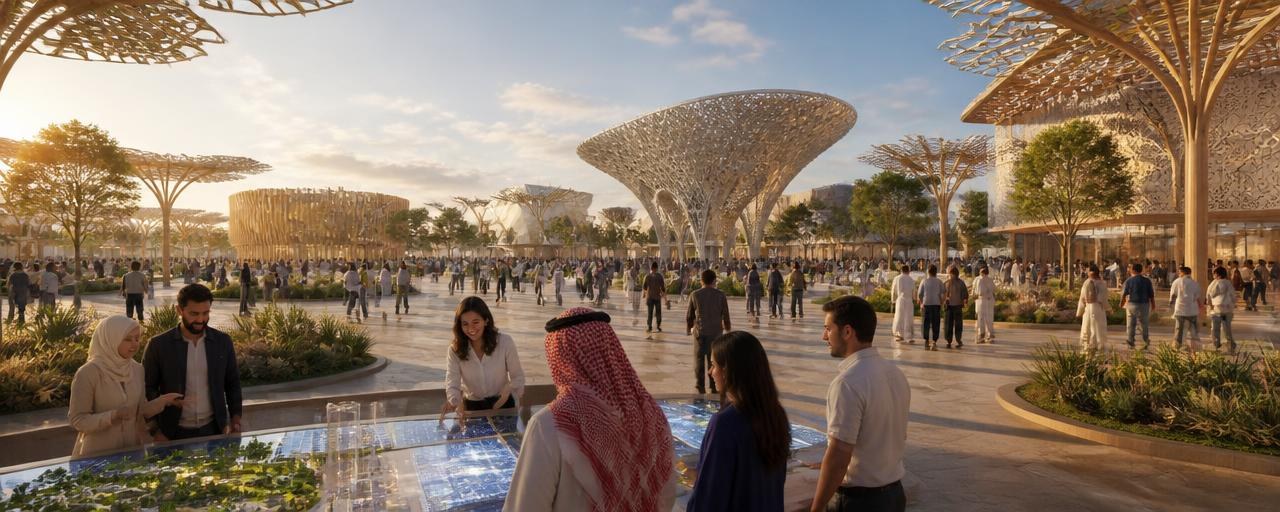
Riyadh Expo 2030: a World Expo in North Riyadh
Expo 2030 Riyadh is scheduled for 1 October 2030 to 31 March 2031 at a purpose-built site in North Riyadh, Saudi Arabia. It is a six-month international exposition where participating countries are expected to present their perspectives and innovations through national pavilions, alongside themed districts and public spaces. The official site describes a meeting place for international collaboration, knowledge exchange and responses to shared challenges. Its current plan spans six million square metres; the detailed visitor programme and operating arrangements should be checked with the organiser as the event approaches.
The Expo is planned as both a public experience and a platform for participation. Visitors can explore country pavilions and themes including technology, sustainability and thriving communities. Governments, suppliers, service providers and commercial partners have separate participation routes, while the official site also describes volunteering and school programmes.
Why Riyadh Expo 2030 matters
Encounter different national perspectives
Each participating country is planned to have a pavilion where it can present its own vision. For visitors, this creates a way to compare how different places frame future challenges and potential responses rather than seeing one single viewpoint.
Explore connected global themes
The official site describes international collaboration around climate, technological change and human wellbeing, and a site plan organised around technology, sustainability and thriving communities. These themes give visitors a useful starting point for choosing what to explore and what questions to take away.
Understand the planned scale
- Six million square metres: the total site area in the published plan.
- Two million square metres: the planned gated area.
- Four million square metres: planned for logistics and services.
- Five thematic districts and more than 230 pavilions are described in the organiser's site information.
- 197 official participants and more than 42 million visits are current organiser expectations, not completed attendance results.
The area and participation figures point to an extensive site and many planned exhibits. Visitors are likely to benefit from prioritising interests and checking the site map and programme before setting out.
Who should visit Riyadh Expo 2030?
Curious public visitors
Useful if you want to explore how countries and communities imagine the future. Consider choosing a few themes before arrival, then leave room for pavilions or public spaces that catch your attention. The organiser presents the Expo as a public platform for global exchange and discovery.
- Compare how participating countries present their priorities.
- Follow a theme such as technology, sustainability or thriving communities.
- Make time to reflect on ideas that differ from your own expectations.
School groups and learners
Useful for educators and students looking for a live setting in which to discuss innovation and global challenges. The official participation information describes school programmes as an experiential learning opportunity. Teachers may want to connect a visit to a classroom question, prepare a short observation activity and check the organiser's educational information when details are available.
- Choose one or two questions for students to investigate.
- Ask learners to compare examples from different country pavilions.
- Record how an exhibit connects an idea with a practical application.
National participants and pavilion teams
Useful for official participants preparing a country pavilion or contribution. The organiser describes each country as having a dedicated pavilion space. Teams can use the event to present national priorities and innovations to an international public; their plans should be built around the country's approved participation scope, pavilion brief and delivery requirements.
- Define the central message the pavilion should communicate.
- Plan how visitors will understand and interact with the content.
- Coordinate interpretation, accessibility, staffing and operational needs with the organiser.
Suppliers, service providers and commercial partners
Useful for organisations whose capabilities match the construction, fit-out, technology, supply-chain or service needs of a major site. The official site identifies supplier registration, vendor participation and commercial partnerships as routes to take part. These are routes for expressing interest, not guarantees of a contract or access to a procurement opportunity.
- Match your offer to a clearly defined site, technology or service requirement.
- Prepare evidence of relevant delivery experience, capacity and compliance.
- Use the organiser's current supplier and partnership information to understand the applicable process.
What can you find at Riyadh Expo 2030?
National pavilions
The organiser's plan provides for a pavilion for each participating country. The content of individual pavilions will be determined by their official participants; no specific national exhibits should be assumed until those participants publish details.
Technology and innovation
Technology is one of the planned thematic districts. Visitors may want to look for examples that show how a technology addresses a defined need, who it is intended to serve and what conditions are required for it to work in practice.
Sustainability and climate-responsive design
The site information describes climate-responsive design, clean energy and a circular approach, including a reported 30% of site-clearance debris recycled. It also identifies zero-emissions on-site logistics as a design aim. These are site-planning features, not a claim that every pavilion or operation will have the same performance.
Thriving communities, education and human wellbeing
The official material connects the Expo with communities and human wellbeing, and describes school programmes intended to make learning experiential. Specific programme sessions, performances or demonstrations should be checked with the organiser when they are published.
What makes Riyadh Expo 2030 different?
The plan combines international pavilions with a large purpose-built site intended to remain useful after the six-month event.
The organiser describes a site of six million square metres, including a two-million-square-metre gated area and four million square metres for logistics and services. Five planned thematic districts are intended to help visitors move between different parts of the Expo. The site is also designed around climate-responsive architecture, clean energy, smart mobility and long-term infrastructure.
After the Expo, the site is planned to transition into a Global Village with housing, cultural and entertainment spaces and business districts. This is a stated legacy plan, rather than a description of facilities already operating. Together, the international pavilion programme and the site plan make the event relevant to both public visitors and organisations involved in large-scale delivery.
What should you try to achieve during Riyadh Expo 2030?
A visit across a site of this planned scale can become a long walk without a clear purpose. Choose a question that will make your time useful.
If you are a public visitor
Objective: compare three different ways participating countries present one shared future challenge, and note the idea you want to explore further.
If you are visiting with students
Objective: help each group gather examples from two pavilions and explain how each example relates to the class's chosen question.
If you represent a country or pavilion team
Objective: leave with a clear content plan, visitor journey and list of operational dependencies for the pavilion's next planning stage.
If you are a supplier or partner
Objective: identify which published requirements match your capabilities, what evidence you need to provide and which formal follow-up route applies.
How to prepare before Riyadh Expo 2030
1. Decide what you want to understand
Choose a practical focus: a global challenge, an area of technology, a sustainability question, an educational objective or a participation opportunity. A specific question makes it easier to select pavilions and sessions once the organiser releases visitor information.
2. Check official visitor information
Use the organiser's current information for visitor registration, ticketing, access arrangements, opening hours, the site map and programme. These details can change before a 2030 event and should not be inferred from the current site plan. If you are attending as a school, supplier, official participant or partner, use the relevant participation information rather than assuming public visitor arrangements apply to you.
3. Build a short priority list
When the official participant and programme details are available, sort your priorities into three groups: A — essential pavilions or activities; B — useful additions; C — explore if time allows. Grouping priorities by district may reduce backtracking once the final site map is published.
4. Prepare questions that fit your purpose
- For visitors: What problem is this idea addressing? Who benefits? What evidence or example supports it?
- For educators: What can students compare, observe or explain after seeing this exhibit?
- For official participants: What message, visitor interaction and operating requirement should the pavilion deliver?
- For suppliers: What is the scope, specification, qualification process, delivery schedule and service requirement?
5. Plan access only from current guidance
The official site describes a dedicated Expo station on Riyadh's metro network, the airport as one metro stop away, taxi and ride-share access, and road access via Airport Road and King Salman Road. Confirm the operating arrangements, routes and travel time closer to your visit; the transport network and event-day procedures may be updated.
How to make the most of the Expo site
Use the published map and programme, once available, to organise the day around a small number of priorities. The six-million-square-metre site plan includes a gated visitor area and separate logistics and service areas, so do not assume every part is open to visitors or that distances will be short.
For each pavilion or activity, keep a simple note: Place or participant → idea → evidence or example → why it matters to me → next question. This helps a public visitor remember what stood out, a student compare observations and a professional distinguish an interesting idea from one relevant to a project.
At the end of a district, review what you have seen and decide whether to continue, take a break or adjust your plan. Use the official wayfinding and accessibility information when it becomes available rather than relying on a pre-event estimate of walking times.
Plan your time realistically at Riyadh Expo 2030
The event is scheduled to run for six months, but the size of the planned site and the number of pavilions make it unrealistic to treat every visit as a complete tour. The exact daily opening schedule and visitor facilities were not established in the information reviewed.
- For a focused visit: choose one district or theme and a small set of pavilions or activities.
- For a broader visit: compare several country perspectives on one topic, allowing time to move between them.
- For a school visit: prioritise the learning activity and allow time to gather and discuss observations.
- For professional participation: separate public exploration from scheduled meetings or operational commitments, using confirmed organiser timings.
Once the event publishes its map, opening hours and programme, use those details to set a realistic route. Avoid planning around unverified travel times or assuming every pavilion will require the same amount of time.
Travelling to Riyadh Expo 2030
The official Expo site places the venue in North Riyadh. Its current access information says King Khalid International Airport is one metro stop from the Expo site and describes a dedicated Expo station on Riyadh Metro, which has 85 stations. It also identifies taxi and ride-share services, plus direct road access via Airport Road and King Salman Road.
These are the organiser's current site-planning details, not a substitute for the final event travel plan. Before travelling, confirm station operations, event-day access, road arrangements, parking, accessibility, airport connections and any shuttle information in the organiser's latest visitor guidance.
After Riyadh Expo 2030: keep the value of your visit
Record useful ideas while they are fresh. Public visitors may want to note a pavilion, theme or perspective to revisit; students can organise observations against their learning question. Official participants and suppliers can record decisions, open requirements and agreed next steps without treating an informal conversation as a commitment.
- A — Immediate: follow up on a specific action or information request that was formally agreed.
- B — Potential: retain a useful contact or idea for further evaluation.
- C — Reference: save broader observations about themes, approaches or visitor responses for later review.
For commercial or project decisions, verify specifications, procurement conditions and responsibilities through formal channels after the event. For learning visits, ask participants to summarise what changed in their understanding and which questions remain open.
Who should consider taking part in Riyadh Expo 2030?
The official site describes several distinct participation routes. Countries can prepare dedicated pavilions; organisations can explore supplier and commercial partnership channels; individuals may be able to volunteer; and the organiser describes educational programmes for schools. Each route has different requirements and timing.
Suppliers and service providers may find the event relevant where their capabilities relate to site delivery, fit-out, technical solutions, supply chains or visitor services. Before pursuing a route, check the organiser's current process, eligibility, specifications and deadlines. Do not treat an expression of interest or supplier registration as confirmation of a contract.
For country teams, the key questions are how the pavilion will represent the country's priorities, what experience it will offer visitors and how content will be operated throughout the Expo. For commercial partners, define the audience, service or project outcome that a partnership would support and confirm the formal terms with the organiser.
Riyadh Expo 2030 visitor checklist
Before
- ☐ Choose a theme, learning question or participation goal.
- ☐ Check the organiser's latest registration, ticketing and programme information.
- ☐ Use the official site map and access guidance when available.
- ☐ For group visits, agree roles and a way to regroup if members become separated.
- ☐ For supplier or pavilion participation, confirm the relevant formal process and requirements.
During
- ☐ Prioritise a manageable number of districts, pavilions or activities.
- ☐ Record the idea, example and question that make each stop useful.
- ☐ Check current wayfinding and accessibility information on site.
- ☐ Leave time to pause and review what you have learned or need to follow up.
After
- ☐ Sort notes into immediate actions, potential follow-up and general observations.
- ☐ Verify any commercial or technical claim before acting on it.
- ☐ For school groups, connect observations back to the original learning question.
Is Riyadh Expo 2030 worth visiting?
Riyadh Expo 2030 may be particularly valuable if you want to explore national perspectives on future challenges, create a structured learning experience or understand a formal participation route. The planned country pavilions, thematic districts and large site give visitors a wide range of possible directions, but the final programme and practical arrangements will determine how to plan a specific visit.
Value will depend on choosing a purpose and using confirmed visitor information to plan around it. A focused route is more likely to support thoughtful comparison than trying to see everything. For suppliers, participants and partners, the relevant measure is whether the organiser's published process and requirements match your organisation's capabilities and objectives.
Riyadh Expo 2030 at a glance
| Item | Information |
|---|
| Event | Expo 2030 Riyadh |
| Dates | 1 October 2030–31 March 2031 |
| City and country | Riyadh, Saudi Arabia |
| Venue | Purpose-built Expo site in North Riyadh |
| Organiser | Expo 2030 Riyadh; the BIE oversees and regulates World Expos |
| Site plan | 6 million m² total; 2 million m² gated area; 4 million m² logistics and services |
| Planned format | Five thematic districts and more than 230 pavilions |
| Current expectations | 197 official participants and 42 million+ visits; organiser projections |
| Visitor themes | Technology, sustainability, thriving communities, climate, technological change and human wellbeing |
| Visitor access information | Dedicated Expo metro station, airport one metro stop away, taxi and road access described by the organiser |
| Programme status | Detailed visitor programme and event-day arrangements should be confirmed with the organiser closer to the event |
Plan around the official information available at the time of your visit; projected scale and site design are not completed attendance results or a final daily programme.
Make a plan for Riyadh Expo 2030
Choose the question you want the Expo to help you explore, then use the organiser's confirmed map, programme and participation guidance to decide what to prioritise. Explore. Compare. Learn. Follow up.
For further information, please click
here .