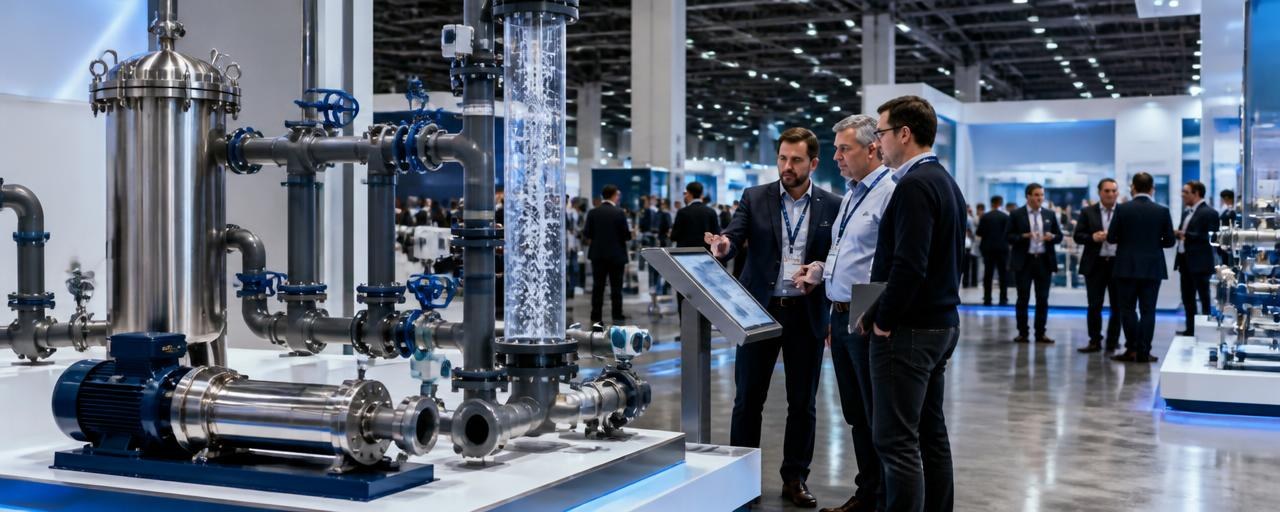
Moscow ECWATECH 2027: event guide
7–9 September 2027 | Crocus Expo, Pavilion 2, Halls 7 and 8 | Moscow, Russia
ECWATECH is the international exhibition for technologies and equipment used in municipal and industrial water treatment, water supply, wastewater management, sewage treatment, engineering systems and pumping. Its scope connects equipment makers and suppliers with the utilities, industrial facilities and technical organisations that design, construct, operate and modernise water infrastructure.
The event is held at Crocus Expo in Krasnogorsk, Moscow Oblast, and is marketed as a Moscow exhibition. The 2027 edition is the 21st; the preceding 20th edition took place in 2026.
Why Moscow ECWATECH matters
Compare technologies across the water cycle
Water infrastructure decisions often depend on how equipment performs as part of a larger system. ECWATECH brings together categories spanning water preparation and treatment, water supply, wastewater, pumping, pipelines, automation and monitoring. Visitors can use that breadth to compare technical approaches and identify questions about compatibility, installation, operation and maintenance.
Assess suppliers and technical fit
Utilities, industrial users, engineering organisations and contractors can discuss requirements directly with manufacturers and suppliers. A useful visit is not simply a tour of stands: compare equipment against the operating conditions, capacity, interfaces, maintenance needs and service expectations of a real project.
Connect the exhibition with professional discussion
The 2026 edition paired the exhibition with conferences, technical discussions, practical formats and business meetings. The organiser’s final report recorded more than 350 individual ECWATECH Connect B2B meetings over two days. These are previous-edition figures, not a promise about the 2027 programme.
Moscow ECWATECH: published 2026 scale
The organiser’s final release for the 2026 edition reported:
- More than 550 manufacturers and suppliers.
- More than 12,700 unique professional visitors from 76 Russian regions and 17 countries.
- More than 21,000 m² of exhibition area.
- Visitors representing more than 230 water utilities and 1,150 industrial enterprises.
- The business programme included 12 events, more than 90 hours of professional discussion, over 600 participants and 120 industry experts.
These published figures describe the 2026 edition. They provide a scale reference for planning, not a forecast for 2027.
Who should visit Moscow ECWATECH?
Water utilities and municipal infrastructure teams
Useful if you are responsible for operating, upgrading or planning water and wastewater services. Prioritise equipment and systems related to your immediate needs, such as treatment, pumping, pipeline renewal, monitoring or automation. Bring a clear description of site conditions and the operational problem you need to solve; ask suppliers about integration, maintenance, spare parts and service support.
Industrial enterprises and facility teams
Manufacturing and other industrial organisations can compare water-treatment, supply, wastewater and reuse-related technologies against process requirements. Check the quality and flow conditions that a solution is designed for, its control and monitoring interfaces, consumables, maintenance intervals and the evidence needed for internal technical review.
Engineers, designers and project organisations
Project and design teams can use the product range to review available equipment and identify specification questions early. Compare connection requirements, performance parameters, installation constraints and operating support. Record the manufacturer, model, relevant parameters and documents needed for a later design or procurement decision.
Contractors, installers and service providers
Construction, repair and maintenance teams may focus on equipment and systems for building, diagnosing, rehabilitating and operating municipal pipelines and treatment infrastructure. Ask about installation methods, access constraints, commissioning, maintenance and the division of responsibilities between supplier and contractor.
Procurement teams, distributors and equipment suppliers
Buyers and distributors can use the exhibition to compare suppliers, product ranges and commercial fit. Manufacturers and technology providers can assess potential channels and discuss technical requirements with professional visitors. The event creates opportunities for conversations; it does not guarantee contracts, purchase decisions or access to any particular organisation.
What can you find at Moscow ECWATECH?
Water treatment and water quality
- Water preparation, purification and filtration equipment.
- Technologies for drinking and industrial water treatment.
- Water-quality measurement, control and monitoring solutions.
- Water disinfection and treatment-related chemicals and biological processes.
Water supply and pumping
- Water-supply equipment and systems.
- Pumps and pumping systems.
- Water metering, regulation and control equipment.
- Hot-water supply systems.
Wastewater and infrastructure
- Wastewater collection, treatment and disposal solutions.
- Equipment and technologies for sewage treatment and sludge handling.
- Municipal and industrial pipeline systems, including construction, diagnosis, repair and operation.
- Trenchless technologies for installing and repairing underground utilities.
- Engineering systems, automation and monitoring for water infrastructure.
The 2026 final release also highlighted domestic instrumentation and control systems, water-treatment automation, pumps, municipal equipment, modular treatment facilities and digital infrastructure-management technologies. These are examples from the previous edition; the final 2027 exhibitor and product information should be checked when published.
What makes Moscow ECWATECH distinctive?
The exhibition covers interconnected water infrastructure needs, from treatment and supply through wastewater and pipeline systems. That breadth can help visitors compare equipment categories within one professional setting rather than treating each system as an isolated purchasing decision.
The event also has a professional programme alongside the product displays. In 2026, the organiser reported 12 programme events and more than 90 hours of discussion; topics included treatment-facility modernisation, digitalisation, energy efficiency, environmental control and new technologies. The 2027 session list was not yet published at the time of research, so use the 2026 programme only as a guide to the previous edition.
Set practical objectives for Moscow ECWATECH
For a utility or industrial buyer
Example objective: shortlist suitable suppliers for one defined treatment, pumping, monitoring or pipeline requirement. Record the operating conditions, required performance, project stage and decision process before comparing solutions.
For an engineer or designer
Example objective: identify equipment options and document the technical information needed to test them against a design. Capture specifications, interfaces, installation envelopes and maintenance assumptions for follow-up.
For a contractor or service provider
Example objective: compare methods and equipment for a specific construction, diagnostics, repair or operation task. Clarify site constraints, commissioning needs and support responsibilities.
For an exhibitor or distributor
Example objective: identify the visitor roles and partner types most relevant to a defined product line. Prepare concise technical information and questions about applications, service coverage and channel requirements.
How to prepare before Moscow ECWATECH
- Define the decision. Choose a project, operational issue or product category to focus on. Write down what must be solved and which technical or commercial conditions are non-negotiable.
- Build a target list. Use the official exhibitor catalogue when the 2027 directory is available. Check company product categories in advance and group targets into must-meet, useful and if-time-allows priorities.
- Prepare water-sector questions. Ask about design conditions, capacity and performance, water-quality requirements, energy use, controls and data interfaces, installation, commissioning, consumables, maintenance, spare parts and service arrangements. Select only questions relevant to your application.
- Bring project context. A concise process description, system diagram, operating parameters and project timeline can make technical discussions more specific. Share confidential drawings or data only under your organisation’s normal controls.
- Check participation information. The official visitor page said 2027 registration was due to open at the beginning of 2027 and offered a free visitor badge. Check the current registration status and event arrangements before travelling.
How to use the exhibition efficiently
Use a consistent comparison note for every relevant stand:
- Company and product: record the supplier and the exact equipment or system discussed.
- Application: note the water, wastewater or infrastructure duty it may address.
- Technical fit: list the operating conditions, performance information and interfaces to verify.
- Lifecycle: ask about installation, commissioning, maintenance, consumables, spare parts and service.
- Next action: specify what information, quotation, technical review or internal approval is needed, and who will follow up.
For equipment comparisons, distinguish confirmed specifications from points that still need a supplier document or engineering review. A stand conversation is a starting point, not a substitute for checking the design basis and procurement requirements.
Business programme and activities
The official programme page showed the 2026 programme as an archive when checked. It described an engineering and technology forum for water-sector specialists, a practical-solutions format, conferences, B2B meetings, industry awards and training. In the 2026 final release, the organiser reported discussions on treatment-facility modernisation, digitalisation, energy efficiency, environmental control and technology applications, alongside ECWATECH Connect meetings.
The 2027 programme had not been published on the official programme page at the time of research. Review the new schedule when available and prioritise sessions that directly support your technical or purchasing objectives. Previous-edition sessions should not be assumed to return unchanged.
Plan your three days at Moscow ECWATECH
The event runs across three days, with the official visitor page listing different closing times on the final day. Your own plan can adapt to the scale and purpose of the visit:
- First day: orient yourself, confirm priority stand locations from the official directory when available, and begin the highest-priority supplier discussions.
- Second day: complete technical comparisons, attend relevant programme sessions when published and revisit shortlisted suppliers with more detailed questions.
- Final day: close remaining information gaps, confirm follow-up actions and review your notes before leaving.
Allow time between appointments for technical conversations and for recording what you have learned. The 2026 exhibition covered more than 21,000 m², so grouping nearby priorities and leaving room for follow-up discussions may help manage time.
Getting to Moscow ECWATECH
The event venue is Crocus Expo, Pavilion 2, Halls 7 and 8. The organiser’s visitor page gives the venue address as Mezhdunarodnaya Street 18, Krasnogorsk, Moscow Oblast, and identifies Myakinino metro station on the Blue Line. It also lists access from Volokolamskoye Highway and free parking from 07:00 to 20:00. Check current transport, access and parking arrangements with the organiser before travelling, as event-day arrangements may change.
Opening hours
- 7–8 September 2027: 10:00–18:00.
- 9 September 2027: 10:00–16:00.
These are the visitor-facing hours shown on the official event site when checked.
After Moscow ECWATECH: turn comparisons into decisions
Within a short time after the exhibition, sort your notes by urgency:
- Immediate: suppliers or technical points linked to an active project or operational need.
- Further evaluation: options that need engineering review, a site assessment or additional documentation.
- Market information: technologies or suppliers worth tracking but not yet tied to a procurement decision.
For each shortlisted solution, request the documentation needed for a fair comparison: performance data under relevant conditions, installation requirements, control interfaces, operating and maintenance needs, consumables, spare-parts availability and service scope. Share the findings with engineering, operations and procurement colleagues before deciding on next steps.
Who should consider exhibiting at Moscow ECWATECH?
The official exhibitor information identifies product and service areas including treatment, water supply, wastewater, pumping, engineering systems, automation, monitoring, pipeline infrastructure and trenchless technologies. Manufacturers and suppliers in these fields may find the exhibition relevant when they can demonstrate a clear application for municipal utilities, industrial enterprises, engineering organisations or infrastructure contractors.
Before committing to a stand, define the business objective: product evaluation discussions, distributor conversations, technical visibility or a focused set of buyer meetings. Prepare clear application information and an approach for recording enquiries. The 2026 organiser report recorded more than 350 individual B2B meetings through ECWATECH Connect; this is a result reported for that edition, not a guarantee or a forecast for 2027.
Moscow ECWATECH visitor checklist
Before the exhibition
- ☐ Confirm visitor registration and the latest event information.
- ☐ Choose a defined water-infrastructure or industrial objective.
- ☐ Review the 2027 exhibitor directory and programme when released.
- ☐ Prepare project requirements and technical questions.
- ☐ Check travel and venue access arrangements.
During the exhibition
- ☐ Prioritise treatment, supply, wastewater, pumping, pipeline or automation suppliers relevant to your goal.
- ☐ Record product specifications, application fit and points that need verification.
- ☐ Separate confirmed information from claims requiring documentation.
- ☐ Note a named contact and a specific follow-up action for each useful discussion.
After the exhibition
- ☐ Compare shortlisted solutions against the same technical and lifecycle criteria.
- ☐ Share useful information with engineering, operations and procurement stakeholders.
- ☐ Follow up on priority documentation and agreed next steps.
Is Moscow ECWATECH worth visiting?
Moscow ECWATECH is most relevant to professionals who specify, buy, build, operate or maintain water and wastewater systems, and to suppliers whose technologies address those needs. Its published 2026 scale and broad product scope support a substantial comparison opportunity. The value of a visit depends on matching the exhibition to a real technical or procurement question and following up on the evidence gathered; an unplanned walk through the stands is less likely to produce useful comparisons.
Moscow ECWATECH 2027 at a glance
| Item | Information |
|---|
| Event | Moscow ECWATECH |
| Edition | 21st international exhibition |
| Dates | 7–9 September 2027 |
| Venue | Crocus Expo, Pavilion 2, Halls 7 and 8 |
| City / location | Moscow, Russia; venue in Krasnogorsk, Moscow Oblast |
| Organiser | OOO EVR |
| Main industries | Water treatment, water supply, wastewater, pumping and water infrastructure technologies |
| Main audiences | Water utilities, industrial enterprises, engineers, procurement teams, project organisations and contractors |
| Latest published scale | 2026: 550+ manufacturers and suppliers; 12,700+ professional visitors; 21,000+ m² |
| Opening hours | 7–8 September: 10:00–18:00; 9 September: 10:00–16:00 |
| 2027 programme | Not yet published on the official programme page when checked; 2026 programme available as an archive |
Make your ECWATECH visit purposeful
Which water-system decision, supplier comparison or project question do you want to resolve? Set that goal before you arrive, use the exhibition to test options against your requirements, and leave with clear follow-up actions. Discover. Compare. Discuss. Verify. Decide.
For further information, please click
here .